BP004
Blue Reactors

Powering Europe
with Nuclear
A 21st Europe blueprint
with Mattering
Europe's prosperity has always followed power.
Coal powered the industrial age. Oil shaped the twentieth century. The electric grid transformed how Europeans lived and worked. Where energy was plentiful and affordable, industry grew and societies could invest confidently in the future.
That confidence is now tested on two fronts. The climate crisis demands that Europe move away from fossil fuels, and fast. Meanwhile, volatile prices and dependence on imported fuel have turned energy into a strategic vulnerability. Decarbonisation and independence have become the same task: every fossil fuel replaced with Europe's own clean power cuts both emissions and dependence, and makes European industry more competitive in the process.
The question was never renewables or nuclear. It is how to build a mix that is clean, affordable and dependable, and lets Europe grow on its own terms.
Everything in Europe runs on energy, from homes and hospitals to factories and data centres. Whoever controls it shapes the future, including how livable that future will be. Europe has reinvented itself before, rebuilding its industry after two World Wars and its markets after the Wall came down. Now it needs that same resolve for the foundation beneath everything else.
Renewables have made real progress and must keep growing. But wind and solar alone would have required decades of investment in storage and grids that never happened at the scale needed. Ruling out nuclear keeps fossil fuels in the system longer and makes the transition more expensive.
Alongside extending the life of Europe's existing reactors, Blue Reactors proposes a continent-wide network of small modular reactors (SMRs): compact nuclear reactors built from standard parts in factories and assembled on site. They can be deployed faster, placed closer to where power and heat are needed, and added step by step as demand grows. What sets Blue Reactors apart is that it treats them as one European system rather than a set of national projects: a shared design system, a connected network and infrastructure built to be seen and understood by the public it serves.
QUOTE
Control of energy is control of the future.

Today’s Situation:
Competitiveness at Risk
Our research and expert insights highlight four key factors shaping Europe’s energy landscape today. These findings provide the foundation for understanding why clean energy must be reimagined for the century ahead.
01: Investment Uncertainty
Europe has grown steadily over the last several decades, but more slowly than the economies it competes with. According to the Draghi report on EU competitiveness, had the EU matched US growth since 2000, its economy would be roughly €2 trillion larger today. Europe has the talent and ideas to compete, but too often they are turned into companies and products elsewhere. To keep them here, Europe needs the abundant, reliable energy that allows ideas to grow.
The 2022 energy crisis exposed how vulnerable Europe is to volatile prices and imported fuel. Poor in fossil resources of its own, Europe has long depended on others for the energy behind its prosperity. Draghi points to the way out: decarbonisation can strengthen competitiveness by cutting that dependency and expanding clean sources with low running costs, such as renewables and nuclear. Industry is asking for the same. Through the Antwerp Declaration, European industry has called for a competitive, sustainable future that keeps quality jobs in Europe, and the Clean Industrial Deal sets out to revitalise industry while advancing decarbonisation. The industries shaping the next economy, from AI and advanced manufacturing to clean transport, need energy they can rely on and afford.
02: AI and Data Centre Surge
Artificial intelligence, quantum computing and other advanced technologies are driving a rapid rise in electricity demand. Europe's data centres consumed an estimated 70 terawatt-hours of electricity in 2024, roughly as much as all of Spain's households use in a year. By 2030, that is expected to reach 115 terawatt-hours, roughly the household electricity use of Germany. Meanwhile, transport, heating and industry are gradually shifting from fossil fuels to electricity, as fast as the grid can generate and carry it. Electrification only decarbonises if the electricity itself is clean.
Europe's next economic transformation runs on power. Data centres need uninterrupted electricity, 24 hours a day, and in parts of Europe, growth is already held back because there simply isn't enough clean power available. Without a secure, steady supply, Europe risks falling behind in AI and digital infrastructure, not for lack of ambition, but for lack of the power to back it.


03: Strong on Paper
Nuclear is one of the safest, lowest-carbon ways to make electricity. Counting every accident, including Chernobyl and Fukushima, it accounts for around 0.03 deaths per terawatt-hour. That puts it alongside wind and solar, and hundreds of times below fossil fuels.
It is also reliable. Nuclear plants run more than 90% of the time, day or night, in any weather, which wind and solar can’t do alone. For industry, that predictability is competitiveness. Neither a factory nor a household can run on power that comes and goes.
Nuclear is usually framed as energy or weapons, yet its science is already part of daily life. It treats patients, desalinates water, sterilises surgical equipment and preserves food, and could help produce sustainable aviation fuel. Beyond electricity, it supplies steady heat and steam at the high temperatures steel and chemical plants need, which renewables struggle to deliver affordably. It is a familiar technology with an unfamiliar reputation.
None of this explains why nuclear stalled in Europe. The challenge has been turning a strong case on paper into something Europe is willing and able to build.
By the numbers
Approximately 23% of EU electricity comes from nuclear today.
60–80 years is the operational lifespan of modern nuclear plants.
0.03 Deaths per TWh generated on average from nuclear, ranking it alongside solar and wind as one of the safest major energy sources.
300,000 homes can be powered by one SMR per year
04: Safety and Stability
Nuclear is already a bigger part of Europe’s energy system than its reputation suggests. It produces nearly a quarter of the EU’s electricity, though that share has been slowly shrinking as older reactors close. France generates around two-thirds of its electricity from nuclear, the highest share of any country in the world, and Slovakia, Belgium, Hungary, Finland and Sweden each draw between a quarter and three-fifths of theirs from reactors, some running safely for more than forty years. Extending the life of these reactors is part of Europe’s path to a clean energy supply.
That record is no accident. Europe’s reactors are built on "defence in depth": layer upon layer of independent safety systems, each able to act if another fails, and protection that shuts a reactor down automatically without waiting for an operator. It is a legal requirement under EU law, alongside the goal that a large release of radiation is practically ruled out for new reactors. Since 1957, the Euratom Treaty has also made safeguards binding EU law, with European inspectors verifying that nuclear material is used only for peaceful purposes.
Public perception has not kept pace. Nuclear is still closely tied to the memory of Chernobyl in 1986, a Soviet design with no containment structure and reactor physics no longer permitted today, and Fukushima in 2011, which led Germany to phase out nuclear entirely by 2023. Each accident, along with Three Mile Island in 1979, permanently reshaped how reactors are regulated, designed and run, and Europe’s standards are among the strictest in the world as a result.
But engineering alone won’t change how people feel. For many Europeans, nuclear is a black box: distant, closed off and remembered mostly for the moments it failed. Research shows that people who know nuclear is low-carbon are far more likely to support it. Earning trust means starting from transparency: making visible what has been hidden, being honest about what can still go wrong, and involving people before decisions are made, not after.
BP004

21st Europe:
Better by Design
Europe's energy transition will not succeed through policy alone. It must be designed — systemically, visibly, and with intention.
For too long, energy infrastructure has been treated as a technical background: distant, industrial, and politically reactive. It's most present when it fails. But infrastructure shapes culture. It signals what a society values. It determines what becomes possible — the invisible layer that enables everything else.
Blue Reactors reframes nuclear not simply as an energy supply solution, but as an investment in Europe's belief in itself and in its own future. Europe's ability to innovate and thrive depends on its ability to fuel those ambitions, and the success of nuclear energy depends on Europe's ability to trust it enough to integrate it at scale.
Nuclear is one key piece in the larger puzzle of Europe’s next economic transformation. Built closer to the places that need power, working alongside renewables, and designed to European standards, it can help make clean energy more reliable, affordable and European.
Design makes infrastructure transparent. Transparency builds trust. Trust unlocks the conditions needed to scale Europe's ambition for its own future.
Quote
Infrastructure shapes culture. It signals what a society values.
Johanna Fabrin
21st Europe

BP004

Welcome to Blue Reactors
Blue Reactors is a blueprint for a Europe that powers itself.
As the climate crisis accelerates, energy prices keep swinging, and geopolitical uncertainty reshapes global alliances, Europe’s energy system has become central to its future prosperity. Yet nuclear power — despite major advances in safety, modularity, and sustainability — is still viewed through outdated imagery.
Blue Reactors proposes a European network of small modular reactors (SMRs), working alongside wind, solar and other renewables to provide reliable, low-carbon electricity. Smaller than conventional nuclear plants and designed to be built in repeatable units, these reactors can be placed closer to the industries and communities that need their power while driving down the time and cost of building them.
Blue Reactors treats energy infrastructure not as distant industrial machinery, but as a visible and human-centric asset — embedded in cities, aligned with European values, and capable of powering a sovereign green continent.
Europe’s industrial infrastructure once made its ambitions visible. Blue Reactors asks what the infrastructure of its next ambitious chapter could look like: clean, safe, reliable, and built with confidence in Europe’s future.
BP004
The Reactor:
Built to be Understood
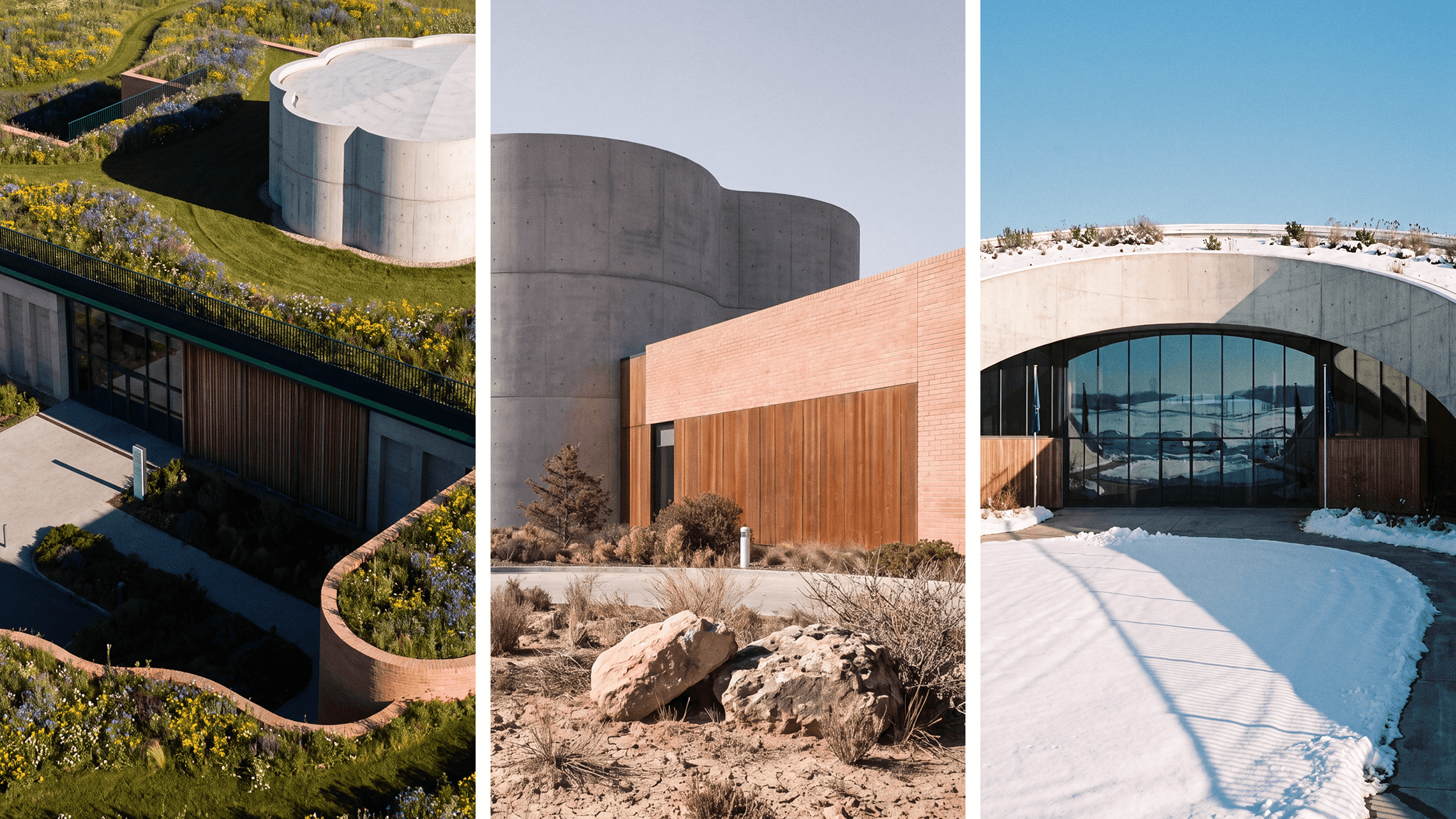
A nuclear reactor is one of the most consequential objects a society can build, and one of the most misunderstood. Blue Reactors starts from the belief that trust is designed, not assumed. Its reactors are built to be understood rather than hidden: visible in their operation, legible in their safety, and honest about what they are.
Their safety is designed in from the core outwards. The reactor’s own physics slows the reaction if it heats up, protection systems shut it down automatically, and passive systems keep it cool using natural forces like gravity and circulation, even without power. SMRs carry the same "defence in depth" that has kept Europe’s fleet safe for decades, with fewer moving parts and less that can go wrong.
Fuel matters too. Europe still imports much of the nuclear fuel it relies on, so building a European fuel supply chain is both a question of security and an opportunity for investment.
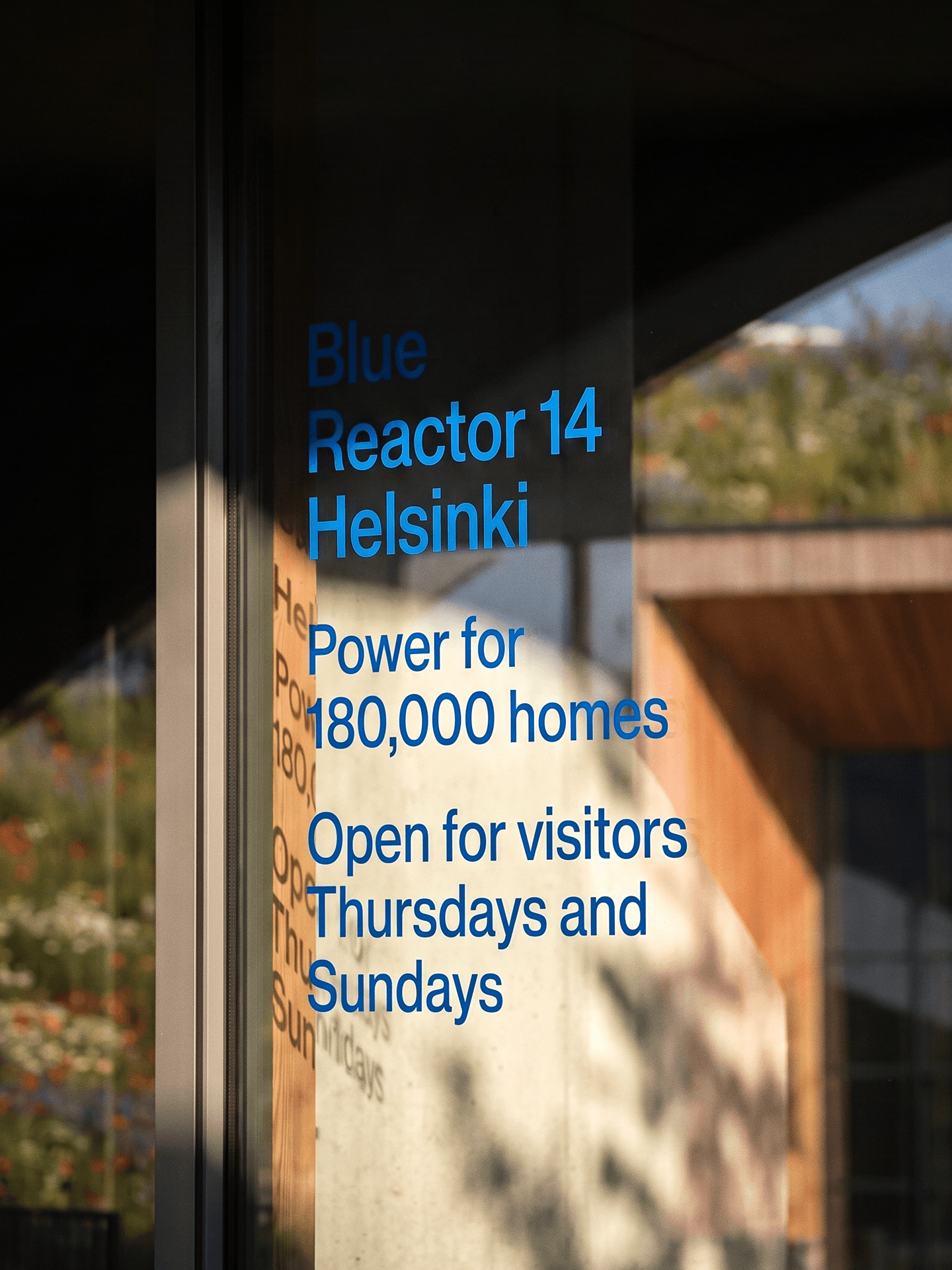
For industry and the public to trust the network, they need to see it working. How much power each reactor is producing, where that power is going, and whether everything is operating safely should be as easy to check as a train time or weather forecast. Paired with a communications and wayfinding system, a distinct visual language traces the journey of nuclear power from reactor to destination, from homes and public buildings to factories, data centres and electric vehicle charging networks.
BP004


Four Sugar Cubes
A year of one person’s electricity, generated entirely by nuclear, leaves behind about 17 grams of spent fuel. That is equivalent to four sugar cubes. Nuclear waste is one of the most carefully tracked materials Europe produces, and there is far less of it than most people imagine.
Around 90% is low-level waste, such as gloves, tools and filters, kept safely in engineered facilities for up to a few hundred years. Less than 3% is the high-level kind, and every gram of it is accounted for. It is solid, not liquid or gas, and sealed in steel and concrete until it can rest deep underground.
Blue Reactors designs for the full journey from the start. France already recycles spent fuel at scale and is exploring how to do the same for SMRs. Advanced recycling could shrink the time high-level waste stays hazardous from hundreds of thousands of years to a few centuries. Finland shows where the journey ends with Onkalo, the world’s first permanent repository for spent fuel, carved deep into the bedrock.
Waste is not a question without an answer. It is an engineering challenge Europe already knows how to solve, and a promise of stewardship it must keep for generations.
BP004
The Standard:
One Design, Twenty-Seven Markets
Europe has 27 national markets, but it doesn't need 27 ways of building the same reactor. Blue Reactors is a modular design system for small modular reactors (SMRs): one shared European standard, built from repeatable components that can be manufactured in factories, shipped and assembled across the continent.
Every reactor built makes the next one faster and cheaper. Standardisation is how nuclear becomes affordable and scalable enough to matter again, turning one-off megaprojects into a product Europe can build in series. It also pulls whole value chains with it, from advanced steel and precision manufacturing to robotics, nuclear-grade materials, digital twins, cybersecurity and AI-driven grid optimisation, and creates lasting demand for high-tech talent.
The Workforce as the Supply Chain
A network on this scale needs people as much as it needs physical infrastructure, and nuclear education requires a strategic revival. Interest in nuclear engineering has declined in countries like Germany, even as university networks elsewhere, particularly in Italy, work to keep the field alive and integrate it into broader curricula.
Cross-border training and certification make engineers, operators and maintenance crews interchangeable across the network, building one European nuclear workforce. That workforce is also the safeguard: one of the most important things Europe can do to manage its past, present and future waste responsibly is to make sure it never runs short of the expertise to handle it safely.
BP004

Safe as Standard
Europe's high standards for safety and regulation are not an obstacle to nuclear. They are what makes it possible. The same rigour that has slowed Europe's nuclear sector can make small reactors safe enough to run at scale, close to the cities and industries they power.
SMRs with passive safety systems shut down and cool themselves without human intervention or external power, so they can qualify for far smaller emergency zones than large plants. Clear, shared rules for this are what allow reactors near urban centres, supplying both electricity and heat.
Today, every country licenses reactors on its own terms, so the same design must prove itself again and again. Under Blue Reactors, a design certified once under common, Euratom-aligned standards would carry that approval across the continent, like a passport. Pooling the work also pools expertise, strengthening national regulators rather than stretching them thin.
Good regulation covers a reactor's whole life. Blue Reactors builds safeguards in by design, from the first drawings rather than added afterwards. It requires waste and decommissioning plans from day one, firm standards for cybersecurity, and open safety data with clear rules for consulting communities before anything is built.
BP004

The Site:
Power Where the Work Happens
Energy infrastructure has long been hidden at the edge of cities, screened off, and treated as something to route around rather than build toward. Blue Reactors proposes the opposite: reactors integrated into green urban spaces and industrial campuses, making the connection between clean energy and quality of life impossible to miss.
Energy Campuses
Rather than isolated plants, Blue Reactors sites are conceived as energy campuses — anchoring industrial parks, data centre clusters, and manufacturing zones with the reliable baseload power they need to operate around the clock. Sited deliberately alongside the industries they power, they shorten the distance between generation and use, and make the relationship between energy and prosperity visible rather than abstract. The campus is the public layer: the architecture, the data, the green space people actually move through. The reactor itself sits inside its own protected ring within that campus — the same way a dam's turbine hall sits behind its own gate inside a park people picnic in.
They are also built for a hotter Europe. In recent summers, some reactors have had to reduce output during heatwaves and droughts, not for safety reasons, but because rivers already running warm and low cannot absorb the plant’s waste heat without harming their ecosystems. Smaller reactors need far less cooling water, and Blue Reactors sites are chosen and designed with that future in mind, using closed-loop and air-based cooling so they keep running through extreme heat without drawing on rivers already under pressure.
The areas around the reactors are designed as green public spaces, creating safe, accessible landscapes that integrate energy infrastructure into the fabric of the places they serve.
Real-Time Information
For industry and the public to trust the network, they need to see it working, and seeing it working is not the same as having access to it. Live data on plant output, grid load, and safety status should be as transparent and accessible as train times or weather forecasts, replacing uncertainty about nuclear with the same everyday familiarity Europeans already have with the infrastructure around them. Transparency lives in the data stream, not in an open gate — the same distinction that lets a reactor sit inside a public campus without the reactor itself being public.
Power When and Where it’s Needed
Europe's demand is rising and uneven — data centres, EVs, heating and industry are adding load the grid wasn't built for, and when supply doesn't keep pace, scarcity gets priced in: higher bills for households, higher costs for businesses, while the largest companies buy their way around it with private contracts and generation. That gap will only widen as Europe competes to lead in AI and advanced industry, both voracious for power. Blue Reactors starts from a different premise: build abundance before scarcity forces rationing. The goal isn't more electricity for its own sake — it's power cheap and reliable enough that people feel it in their bills and jobs, not just hear about it as a promise.
BP004


Dispatched as One
For Blue Reactors to function as more than a network of plants, it needs a digital and physical grid as advanced as its reactors. Nuclear only reaches its full potential when it is supported by a system that balances supply, demand and storage in real time, across borders.
Europe still manages much of its energy system along national lines. Blue Reactors proposes coordinating power across the continent as one system, so nuclear, renewables and stored energy can move to wherever they are needed most.
That system is designed for long-term independence, not only efficiency. Nuclear baseload works alongside solar, wind and battery storage, with smart energy management holding excess power when demand is low and optimising consumption against real-time network activity. This lowers operating costs and hardens the network against shortages.
Intelligence runs through the network, but never through the reactor’s safety systems, which stay deliberately isolated and act on their own. Instead, AI helps keep the fleet running: predicting maintenance before parts wear out, analysing inspections and planning outages, so reactors spend more time producing power and less time offline.
Secure by Design
A nuclear plant has never been undefended, and proximity to people was never the variable that kept it safe — perimeter and design are. The reactors in this network fall under the same security category as the large plants already operating across Europe today, several of which already sit close to major cities and rivers: a controlled site, monitored access, and a dedicated response force, overseen by each member state's designated nuclear security authority, consistent with IAEA physical protection standards and the EU's framework for protecting critical infrastructure.
What changes with SMRs works in the public's favour, not against it. A smaller reactor core holds a fraction of the fissile material that a conventional plant does, and in this Blueprint are built partly or fully below grade — removing the blast access a ground-level structure presents. A network of many small reactors, rather than one large one, limits any single attack to a fraction of total capacity. The containment itself is engineered to withstand the impact of a large commercial aircraft at full speed without a radiological release — a far higher bar than a conventional explosive could clear. Blue Reactors treats security the way it treats waste: as an engineering problem with a well-tested answer, not a reason to put the technology somewhere out of sight.
BP004

The Blue Reactors Setup:
Potential Scenarios
For Blue Reactors to become reality, it must be efficiently operated, transparently governed, and sustainably funded. As a pan-European system, it requires central coordination on safety, standards, and technology, while leaving room for national operators and industrial partners to build and run individual sites.
Governance Model
Blue Reactors builds on the European Commission’s March 2026 strategy for small modular reactors, which already points toward fleet-based deployment and a shared European supply chain. This blueprint proposes the common standards and governance that would let such a fleet work as one network.
A network of this scale requires centralised European governance. Blue Reactors should coordinate deployment through Euratom-aligned safety harmonisation, with integration into the Net-Zero Industry Act to prioritise nuclear supply chains as strategic technologies.
A single set of technical, safety, and licensing standards would ensure that a reactor design approved in one member state is trusted in all of them, removing the duplicated approval processes that slow deployment today.
Governance should sit within the EU framework, with non-EU nations able to participate in an advisory capacity, consistent with existing European energy and transport initiatives.
An independent expansion board should continuously evaluate new sites, technology upgrades, and decommissioning timelines, ensuring governance keeps pace with a technology that will still be operating eighty years from now.
Operating Model
Blue Reactors should be structured as a publicly backed, industrially co-invested system, pairing public oversight with private-sector delivery speed.
Standardised Reactor Design: A shared family of certified SMR designs, built to common technical and safety specifications, so that a reactor licensed in one member state can be replicated in another without starting the approval process from zero.
A Franchise-Based Delivery Model: National utilities and industrial partners operate individual sites under a common European framework, similar to how national rail operators run routes within a shared standard. This lets existing operators bring local expertise while keeping the network consistent across borders.
Shared Workforce and Standards: Cross-border training, certification, and safety standards ensure that engineers, operators, and maintenance crews are interchangeable across the network, building a genuinely European nuclear workforce rather than twenty-seven separate ones.
Independent Oversight and Open Data: Building on the Euratom inspection system Europe already has, an independent European body publishes and verifies live data on plant output, grid load and safety status across the network. Operators supply the data, but they don't certify it themselves, so the public and industry can trust what they see.
Funding Model
The economics of nuclear power are the inverse of fossil generation: the capital goes in before the plant produces a single kilowatt-hour, and the running costs afterward are low and, unusually for energy, predictable for decades. That front-loaded structure is exactly what patient, long-term capital is built to absorb — and Europe has just built more of it than at any point in its history.
In the past two years, the EU has stood up three of the largest capital mobilisation efforts it has ever run: ETCI 2, a €15 billion fund-of-funds already carrying €1.25 billion in EIF and EIB capital; the Scaleup Europe Fund, run by EQT against a €5 billion target with roughly €2.5 billion already committed and its first investments made this autumn; and the SII Fund, a €500 million EIB equity platform built specifically to anchor capital for grid operators and energy infrastructure. None of these instruments were built with nuclear in mind, but each was built for exactly the kind of asset Blue Reactors proposes: long-lived, capital-intensive, and strategically necessary.
Layered with European Investment Bank long-term infrastructure financing, Innovation Fund support for first-of-a-kind modular reactor deployment, InvestEU guarantees to mobilise private capital, EU Green Bonds and NextGenerationEU recovery instruments, and strategic co-investment with industrial partners in steel, hydrogen, AI, and manufacturing, the funding model for Blue Reactors doesn't need to be invented. It needs to be pointed.
BP004

What's Next?
Europe’s green transition will only succeed if it works for people.
Blue Reactors connects decarbonization to something much bigger: reliable power for homes, factories and digital infrastructure, and the ability for Europe to build more of what it needs here.
Much of what this blueprint describes is already within reach. The technology is advancing. The industrial capacity exists. The grid is becoming more connected. And Europe has more capital available for its next transformation than it has had in decades.
Now we need to start putting those pieces together.
Blue Reactors is the first blueprint behind 21st Europe Capital, a co-investment instrument created to help do exactly that. As the technologies and companies identified through our Blueprints become ready for investment, we can help them take the first steps toward the scale Europe needs.
Because energy sits underneath almost every ambition Europe has for the next century.
Quote
Credits
21st Europe
The Blue Reactors blueprint—its vision, research, and orchestration—is the fourth Blueprint developed by 21st Europe. A new think tank, working with Europe's brightest minds to design blueprints that spark conversations and inspire optimism and action for the continent's next chapter.
Mattering
The blueprint has been designed in collaboration with Mattering, a design practice for arts and advanced technologies working across R&D, motion and experiences. The studio works with change in culture and technology to explore new design territories and find new creative languages.
Expert Contributors
The Blue Reactors blueprint has been informed by expert insight in nuclear safety, energy systems and European policy, and by conversations with citizens across five countries in Europe, ensuring it is a viable framework, not just a vision. Contributors include experts from the EU Commission’s Joint Research Centre on Nuclear Safety & Security; Added Values; EDF Pulse; 92 Capital; and Underground Ventures, alongside 10 European citizens who shared how they live with nuclear energy today and how they imagine living with it tomorrow. Additional input is drawn from research conducted by the European Commission Joint Research Centre, the IAEA, SCK CEN, UNECE and EA Energianalyse, among others.